RSS Feed

Thoughts while shaving (my legs)

Posted on

When I was a kid, there was a Boston Globe sportswriter named Ernie Roberts who wrote a beloved column every Saturday called  ”Thoughts While Shaving.” This is surely the greatest name for a newspaper column ever. Ernie would meander conversationally from one topic to the next, each one or two line observation about the Red Sox, Celtics, etc. separated by an ellipsis. In newsroom lingo, that’s called a “Three-Dot Column,” sweetheart.  Every “Thoughts While Shaving” would open with a rundown of what a local sports person ate for breakfast:  ”Good morning! Let’s start with eggs-over-easy, a side of bacon and a fruit cocktail,” or words to that effect. It was cornball, but you … could  … not … look … away.

When I was a nubile journalistress,  I did my share of sneering at the three-dot genre. Why did it seem like nobody under 40 practiced the elliptical art?  Was it a pasture for aging brains that couldn’t sustain a thought?  I’m not sneering now, though.  Old square Ernie, the San Francisco Chronicle‘s Herb Caen, Larry King, dot dot dot … turns out they were all visionaries. Because what is a Three-Dot Column but a primitive form of Twitter?

And now … Thoughts While Shaving (My Legs) …

Good afternoon!  Lunch today:  Safeway “Eating Right” Chicken and Cashew frozen meal, Mcintosh apple, Jell-o 100 calorie chocolate and vanilla swirl pudding cup, glass of water … You know, friends, Eating Right is surprisingly good for a house brand that usually costs 5 for $10. The chicken tastes like it actually comes from the part of the chicken you’re supposed to eat. …  As far as I’m concerned, the Mcintosh is the only real apple and everything else is a hideous mutant. So why are they so hard to find in the Bay Area, dammit? … Athlete/Stripper Name of the Week:  Angel Pagan. Yes, backwards that’s “Pagan Angel.” And he looks like one. Extra points for the recent revelation that the SF Giants outfielder can be found spearfishing in his native Puerto Rico in the offseason. Let’s think about that for a moment. Angel/Pagan. Shirtless/Wet. With a spear in his hand. Mmmmm. Suddenly, I don’t miss Andres “Watch my bare chest ripple as I heft these cinder blocks” Torres anymore. … Now that a month has gone by since the San Jose Sharks jumped the, er, shark, I’m finally able to talk about them in my indoor voice. There’s nothing wrong with this team that a complete housecleaning, starting with Doug “Dr. Evil” Wilson and extending to Joe “30 minutes or less of hockey” Thornton, Patrick “Now you see him, now you don’t” Marleau and Antti “OMG, did we really sign him for four years?” Niemi. The problem is, Wilson really is Dr. Evil, perched up there in his impermeable lair in the rafters, with his haphazard trades, ridiculous contracts, outdated hockey philosophy and free rein over an ownership group as transparent as the Kremlin. Wilson is here to stay, forever and ever, while the once mighty Sharks continue their decline into the Ill-Tempered Sea Basses. … OK, I’ll stop with the sports (for now). … I’m warming up to Megan Draper. If you think of her as Laura Petrie with sexier underwear, she makes perfect sense. … This season of Game of  Thrones is boring me so much, I’m fighting the temptation to just fast forward to the Tyrion scenes. And they’re worth it. Peter Dinklage never disappoints in the complicated hero role he was born to play.  Although, I just realized that if you close your eyes, he sounds an awful lot like The Brain from Pinky and … I’m still getting mail and hits for my “Drag Queen Names” post. It seems that there are an awful lot of people around the world searching Google for drag names. I’ve picked up a couple more:  Joyce D’vision. Ivana Cockatoo. Benedict Cumberbatch. … Well, maybe not that last one. But as my friend Charley points out, it sure sounds dirty. … Speaking of Benedict Cumberbatch,  he’s tearing it up  as a compellingly geeky-sexy Sherlock Holmes on the BBC/PBS modernized reboot, Sherlock. Steven “Doctor Who” Moffatt‘s re-imagining takes the Asperger’s version of Holmes even further than House did. Extra points for implying that Sherlock lost his virginity to Irene Adler — and for explicitly making Irene a dominatrix — in this season’s opener,  ”A Scandal in Belgravia.”  It was like a fan fiction come to life.  Fifty Shades of Cumberbatch, jolly good fun all around. …

We Are Alive

I didn’t dance at Springsteen Tuesday night. I couldn’t. All of a sudden, it seems I’ve become one of those people with lower back pain that intrudes on every aspect of their life, who plods from medical professional to medical professional looking for answers and relief. I was in such pain the night before the show that I contemplated the unthinkable:  not going. But in the end, I came to my senses. It’s Bruce. When he comes to town, you go. So I did, and I sat and when I stood up I couldn’t shake my hips, only sing, clap and nod. In my heart, I was dancing crazy down in the pit, but in reality, I had become one of those sedentary concert people that I used to snark about. In short, I’ve got a bad case of middle-age.

So, I apologize that this isn’t going to be a long analytical review of the E Street Band at HP Arena in San Jose on the Wrecking Ball tour. I can’t sit comfortably long enough to write that piece right now. But I need to put down a few thoughts.

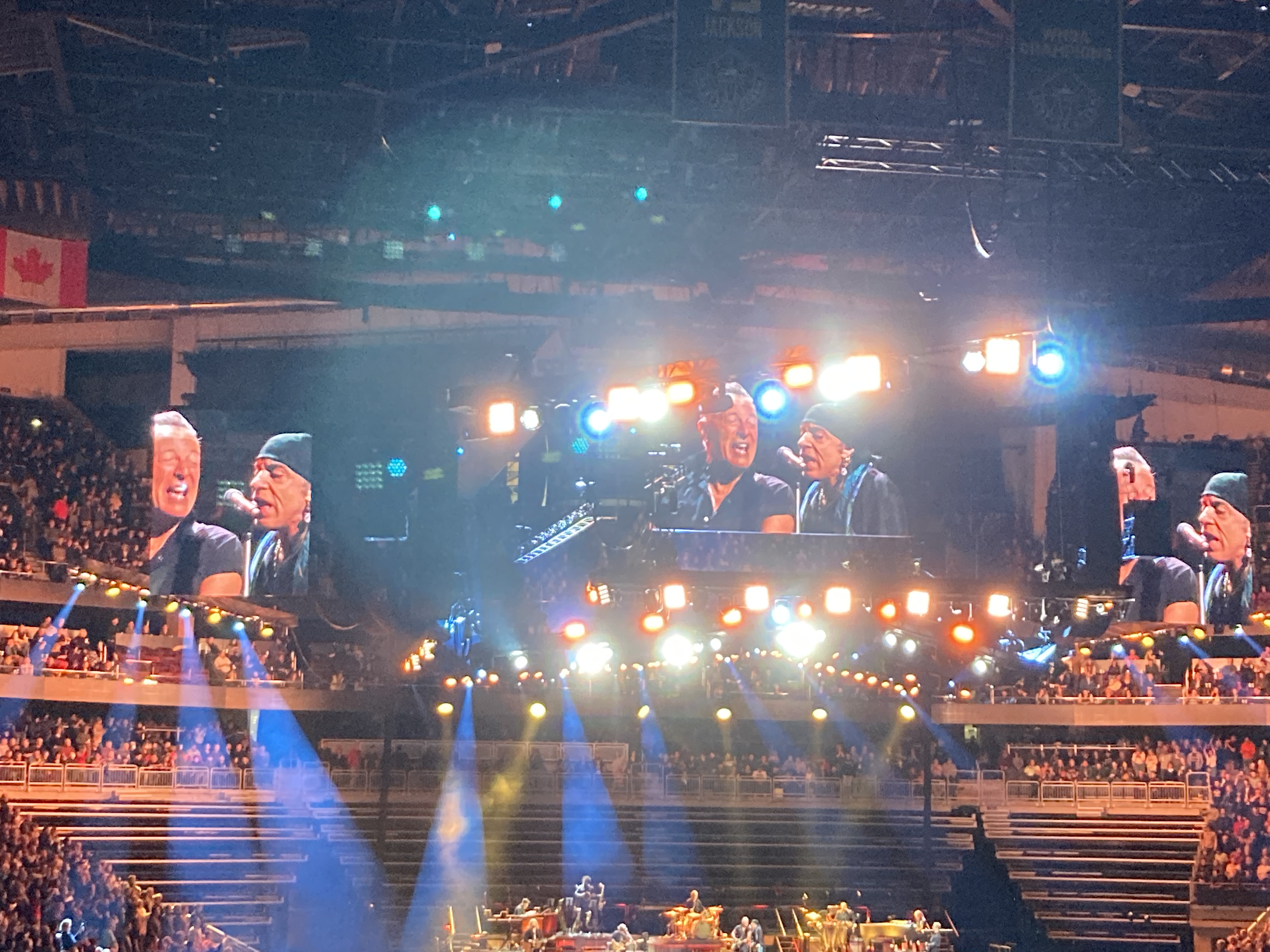
First of all, this was one of the Bruciest Bruce shows I’ve ever seen since moving to the Bay Area in 1987. I was raised on the legendary Boston and Northeast region Bruce shows of yore. But this one was classic, and completely unexpected. The energy in the building was wilder by far than the last two E Street shows I’ve seen there (2002 and 2009). And Springsteen devoured the energy like Pac Man. I never thought I’d see another three-hour Springsteen show, at least on this coast. But there it was, clocking in at 3 hours and 9 minutes. Bruce stage-dived, climbed on the piano, pulled out “Rosalita” and “Backstreets”, kept signalling the band for one more, one more. He’s a little less agile than he used to be — I get the feeling that self-deprecating old-man-shuffle dance he’s doing now is more out of necessity as a breath-catcher than as vaudeville. But then, he can still bend himself backwards from the mike stand, which is more than I can say for myself.

The songs from Wrecking Ball are pretty terrific on the record, but in concert they are luminous (especially “Rocky Ground”), and more so in the context of these shows. This tour is about carrying on. When I first heard that Springsteen was going to tour with the E Street Band again, in the wake of Clarence Clemons’ passing, I wasn’t sure that he hadn’t lost his mind. And to take along Clemons’ young nephew Jake on saxophone?  Is this really a good idea?  But, as he did on his 9/11 album The Rising , Bruce knew exactly what this moment demanded. He grew up on stage with the Big Man by his side. We grew up watching and listening to them. But we’re all older now, some of us are sick, some of us have suffered losses, some of us have been kicked around by life. And we’re learning:  You go on. You have to.

And Tuesday night, when the spotlight found Jake Clemons on the back riser alongside the other horn players, and he nailed, note-perfect, his uncle’s solo on “Badlands,” and then raised his sax in one hand and looked heavenward, I understood. The sax solos are in tribute to Clarence, not in replacement. And Springsteen means this tour  to be a public memorial, a chance for us to grieve together. When Springsteen introduced the band during “My City of Ruins,” and then asked, “Are we missing anybody?,”  the audience seemed to let out a collective sob. “If we’re here, and you’re here, they’re here,” Springsteen repeated. And the final verse — “Without your sweet kiss my soul is lost my friend/ Tell me how do I begin again?” — has never sounded more bereaved, nor the “Rise up” chorus more soothing.

Later, on “Tenth Avenue Freeze-Out,” Springsteen stood on a riser in the middle of a sea of general admission fans on the floor and sang, “The change was made up town when the Big Man joined the band”, and then the music stopped and a montage of Clemons clips played on the video screens, while the band stood at attention and the audience clapped and cried and clapped some more.  And then the band hit the beat and Springsteen continued, “From the coastline to the city all the little pretties raised their hands,” and we raised our hands and Scooter and the Big Man busted this city in half, again.

The necessity of continuing, flesh weak, spirit willing, diminished by age and time, but still alive … yeah, I can relate. “It’s only our bodies that betray us in the end,” Springsteen sang on “We Are Alive,” and the horns strolled down to surround him like a mariachi band, playing the joyous riff from “Ring of Fire.”  And it’s hard to feel miserable when you’re listening to mariachi horns.

I’ve always identified with Springsteen. We were both raised blue collar, we both saw music as salvation, we both became parents the same year, and we’re growing old together. I’ve always needed to hear his music and his message to keep me going, but I really needed it that night in San Jose. So, thanks, my friend. And now, I need an ice pack.

Round and round

Can we just crown Elvis Costello the Greatest Entertainer of His Generation and be done with it?

Punk Elvis, terrorizing Saturday Night Live. Brill Building/Motown Elvis, effortlessly reeling off pop and R&B songs through the Armed Forces/Taking Liberties/Get Happy!!!/Trust years. Country-blues Elvis, riding the mystery train from Nashville to Graceland to Memphis (Almost Blue, King of America, Kojak Variety, The Delivery Man). New Orleans Elvis (Spike, The River in Reverse). Classical Elvis (The Juliet Letters, Il Sogno). Beatles Elvis (Imperial  Bedroom). Rock and roll Elvis (Blood and Chocolate, Brutal Youth, When I Was Cruel). Musicologist/effervescent TV Host Elvis (Sundance Channel’s “Spectacle”). Tin Pan Alley Elvis (National Ransom). And through it all, Wordsmith Elvis, snarly, pithy, sly, clever, gorgeous, peerless.

With his Spinning Songbook tour, Costello has found a singular way to contain, and showcase, his multitude of musical selves. Take one huge carnival Wheel of Fortune, slot it with songs spanning 30+ years of Costellodom, adopt the persona of a cheesy music hall emcee, let audience members spin the wheel and while the song is played, invite them to linger on bar stools at the onstage cocktail lounge or take a turn dancing in the go-go cage.

I was lucky enough to witness the Spinning Songbook show in its first incarnation, in 1986. He revisited the concept last year and, after a few months’ hiatus, he’s back on the road with his traveling carnival. The Spinning Songbook hit San Francisco’s Warfield Theater on April 15, and, of the four Songbook shows I’ve caught since 1986, it was by far the best, in pacing and energy level  – and one of the best of any Elvis show, from any period, I’ve ever seen.

Nearly three hours, folks. So many songs I lost count. It started with Costello and his indefatigable Imposters (keyboardist Steve Nieve, drummer Pete Thomas and bassist Davey Faragher) blasting through an opening volley of “Lipstick Vogue” and “Watching the Detectives,” while a spangles-and-fishnet-clad go-go dancer shimmied in the cage. Costello then donned a top hat and stalked through the audience looking for lucky victims. He emerged with two young women in tow, whom he led to the wheel, claiming that he chose them because they were wearing purple, “the Papal color … and I’m feeling very holy.”  And we were off to the races.

The first spin yielded the rocker “Turpentine” from Momofuku, and a cryptic “Big Boo Little Hoo” card, which turned out to be a medley of crying songs:  The rarity “Big Tears” (yay!) and the ballads “Town Cryer” and “Little Triggers.”  On “Big Tears,” Guitar God Elvis ripped off the first of many lacerating solos, while Crooner Elvis was in fine nuanced, dusky voice on the two ballads, as well as on the other slow-burners that would come up through the night (“The Poisoned Rose,” the Randy Newman-penned “I’ve Been Wrong Before,” George Jones’ “A Good Year for the Roses”).  Subsequent spins (with Costello aided by his statuesque assistant “Katya Valentina Valentine”) turned up songs both well-loved (“Everyday I Write the Book,” “High Fidelity”) and under-appreciated (“Episode of Blonde”, “Deep Dark Truthful Mirror”). There were also wild cards and jackpots, which were basically an excuse for Elvis to delve into multiple tracks along the same theme (like the “Time” slot), or to play whatever the hell he wanted, from “Mystery Dance” to “Uncomplicated” to a jubilant cover of the Beatles’ “Please Please Me.”

The audience participation format is a risk. But for the most part, the San Francisco contingent was more excited than inebriated. Well, except for the blonde chick who crashed the stage uninvited and proceeded to make an air-guitar-windmilling, Irish step-dancing ass of herself at length.

But, back to Costello. The man did not want to stop playing. By my dizzy estimate, the encores alone went on for 45 minutes. By the final two songs, his customary when-in-SF Grateful Dead cover (“Ramble On Rose”) and, of  course, ”(What’s So Funny About) Peace, Love and Understanding,”  Costello and the Imposters were drenched in sweat and we were ecstatically go-go dancing in the aisles. That’s entertainment.

Tales from the bargain bin

Ever since I was a kid, I haven’t been able to pass a remainder table, used record store, cut-out bin, yard sale or Goodwill without  stopping to dig through the books and music for buried treasure. Don’t get me wrong, I’m not an extreme coupon cutter or Dollar Tree fan, and Costco was so depressing I let the membership lapse years ago. I’m particular, too. Five bucks is my absolute limit, under $2 is the sweet spot. And we have to be talking about the good stuff,  like out-of-print gems, releases that fill gaps in my collection, or unfamiliar stuff that I’m willing to take a flyer on if the price is right. Five-for-a-dollar romance paperbacks:  Junk. Autographed first edition of Neil Gaiman’s exquisite fairytale The Graveyard Book for $2.49 in the local Goodwill:  Jackpot!  (One of my best finds ever.)

I learned the art of treasure hunting from my friend Mark Moses, who couldn’t pass a bargain bin without inventorying the goods. He would buy records that he already owned, just to spare them the ignominy of the scrapheap. Of course, Mark had a music critic’s discerning eye and a wide scope of musical interest and curiosity. He knew the worth of each of his finds, and I’m not talking about money, although finding a pristine vinyl copy of Dusty in Memphis for $1 would be an awesome day’s work in itself. In turn, I passed on the record-scavenging jones to my son, who keeps the tradition alive with a fever , and cheapness, that surpasses even my own.

So, I’m going to try something here. This is what (I hope) will be the first installment of an occasional series, depending on what my scavenging turns up. For the first “Tales from the Bargain Bin,” we have two stellar scores.

Amazing Grace by Aretha Franklin. $1.99, San Mateo (CA) Goodwill.  Granted this is the original CD reissue of Aretha’s landmark Grammy-winning 1972 gospel album, not the more recent expanded version. But, when I saw this in the Goodwill CD rack alongside the usual piles of Chumbawumba and Boyz II Men castoffs,  I shouted, “Hallelujah!,” fell to my knees and started speaking in tongues.

Well, not really, but I wanted to. Who gives away Amazing Grace by Aretha Franklin?  Who prices it for $1.99?  But, I’m not complaining. Franklin recorded this live set in L.A. at the New Temple Missionary Baptist Church with a full choir directed by her mentor, Rev. James Cleveland. I have it on vinyl, but I wasn’t passing up this chance to own a version I could put on an iPod. This is Aretha in her prime, pouring her soul into the gospel music of her youth as well as into contemporary songs like Carole King’s “You’ve Got a Friend” and Marvin Gaye’s “Wholly Holy.”  This is the greatest singing you will ever hear. Period. Aretha’s rich, glimmering melisma on “Precious Memories”, her spine-tingling screams of ecstasy on “Amazing Grace”, her roof-rattling testifying on “Mary, Don’t You Weep,” will  take your breath away. Amazing Grace is the holiest record I own. And I say this as a secular Jew and an atheist. I don’t believe, but I am moved beyond words by the joy, the spiritual transcendence, of Sister Aretha’s voice lifted in praise. And that’s religion enough for me.

Love Is a Strange Hotel by Clive Gregson and Christine Collister. $1.99, Burlingame (CA) Goodwill. I would say that this 1990 rarity by two former Richard Thompson associates was my most bizarre, random and unlikely Goodwill find ever, if I hadn’t already stumbled upon a CD of  Thompson’s obscure 1972 solo debut album, Henry the Human Fly, in the San Mateo outpost. And here I thought I was the only British folk nerd on the San Francisco Peninsula.

Clive Gregson and Christine Collister were a folk-rock duo who orbited Planet Thompson in the ’80s;  if you caught his full-band shows during this period, you saw the burly Clive strumming and the pixie-like Christine taking Linda Thompson’s place on duet and backing vocals. Gregson and Collister recorded a handful of albums before going their separate ways, and Love Is a Strange Hotel, which I’d never heard before, is one of their last efforts. It’s a mixed bag (more a demo, really) of covers, including 10 cc’s “The Things We Do for Love,”  Merle Haggard’s “Today I Started Loving You Again” and Bruce Springsteen’s “One Step Up.”  The spare acoustic guitar and keyboard production is crystalline and their harmonies are as lovely as ever. But it’s Christine’s rich, husky, intimate wonder of a voice that should send you on a quest for Gregson and Collister (or Collister solo) finds of your own. Like Linda Thompson and Sandy Denny before her,  Collister draws you in quietly and then devastates you with emotional directness. On the CD’s best track, she shrinks Aztec Camera’s “How Men Are”  from the universal to the personal, with demure vulnerability and plaintive soulfulness. And I always thought Jackson Browne’s “For a Dancer” was pure sap, but Collister’s soaring version over a simple piano accompaniment is, in its plain, Church of England way, as prayerful as Aretha’s revival meeting.

Here are Christine and Clive singing a track from an earlier album, “I Specialise.”

What were your best bargain bin scores?

The 10 Songs You Meet in Hell

It began on a rainy night in San Francisco. (Note that I didn’t write “a rainy night in ‘Frisco,” because nobody who actually lives here calls it ‘Frisco.) My husband came home from work and announced that he just heard the worst song of all time on the radio, “the one by Harry Chapin: ‘It was rainin’ hard in Frisco’ … .”

As soon as he said it,  I had a flashback that came over me like Post-Traumatic Stress Disorder, and I belted, “And she said ‘How are ya, Harry?  And I said ‘How are ya Sue?’ …,”  even though I hadn’t heard “Taxi” since its inescapable reign during the singer-songwriter boom of the early ’70s.  Up from the depths of my subconscious it oozed, this confessional about a cabbie who picks up an old girlfriend on a late-night fare. I was a sucker for singer-songwriter confessionals in my youth, and yet, this one always made me laugh, and not in a good way. I went straight to You Tube to listen to “Taxi” in its entirety and sweet fancy Moses, this song is amazingly bad!  And yet, I can’t stop listening to it. I’ve ranted about it to my Facebook friends. I can’t stop bursting, Chapin-style, into hard-boiled speak-song:  ”She handed me twenty dollars for a two-fifty fare, she said, ‘Harry, keep the change’.”

All of this got me thinking. I’ve already written a post about the 10 songs I’d want to be marooned with on a desert island.   But what are my Top 10 most loathed songs?  What are the songs that, should I be marooned with them, would compel me to hollow out my own leg to make a canoe that would get me off the island (as George Clooney says in his own “Desert Island Discs” list)?

I’m not talking about novelty songs  (“The Macarena,” “Who Let the Dogs Out,” anything by Fergie). I’m talking about real song that were hits, won Grammys, were admired by a fair number of people (some of whom have otherwise impeccable musical taste). To earn a spot on my list, a song had to meet one of the following rigorous qualifications:  it had to make me want to cover my ears and scream, or, leave me in awe of the magnitude of its suckage.

Separating the wretched from the merely bad was no easy task.  Here are a few observations.

  • Phil Collins made a crapload of lousy music in the ’80s.
  • The worst disposable teen-pop song (for the record, it’s Justin Bieber’s “Baby”) is only half as awful as anything by Yes.
  • “Say You, Say Me” by Lionel Richie isn’t as bad as I remembered, but “The Heart of Rock and Roll” by Huey Lewis and the News is much, much worse.
  • Certain songs from the early days of MTV have been so tainted by unintentionally hilarious videos (“I Ran”  by A Flock of Seagulls,  “Love Is a Battlefield” by Pat Benatar, “The Warrior” by Scandal) that it’s impossible to judge them as songs.
  • If a song has “lady” in the title, and it’s by a man, there’s a very good chance that it will be sappy (“Lady” by Kenny Rogers), sexist (“She’s a Lady” by Tom Jones), creepy (“Lady Willpower” by Gary Puckett and the Union Gap) or all of the above (“Lady D’Arbanville” by Cat Stevens).

Now, on with my Ten Least Favorite Songs of All Time

1.  ”(You’re) Having My Baby” by Paul Anka.  This song is even more repulsive today than it was when it was a #1 hit in 1974.  (I’m not sure if Glee is to be chastised or applauded for dragging it into a new generation’s pop consciousness.)  In its time, “(You’re) Having My Baby” was much-reviled by feminists. Ms. Magazine named Anka “Male Chauvanist Pig of the Year”;  NOW gave him its “Keep Her in Her Place” award. For his part, Anka defended     ”(You’re) Having My Baby”  as simply being a love song, and denied that it was an anti-abortion anthem, pointing to the line, “Didn’t have to keep it/ Wouldn’t put you through it/ Could have swept it from your life, but you wouldn’t do it” as acknowledgment of a woman’s right to choose  Maybe so. But there’s still that monumentally paternalistic chorus:  ”You’re having my baby/ What a lovely way of saying how much you love me.” Because, you know, it’s all about him. I’m surprised “(You’re) Having My Baby” isn’t playing on an endless loop in every shaming room in the state of Texas.

2.  ”Muskrat Love” by The Captain and Tennille.  Toni Tennille actually has a great husky, sexy voice. But this song bites harder than a rodent in heat. Speaking of rodents in heat, here’s what the Encyclopedia Britannica has to say about the mating habits of the muskrat:  ”The animal is named for the musky odour of a yellowish substance produced by perineal glands. Secreted into the urine, the substance is used to mark lodges, pathways, and other landmarks throughout an individual’s home range.”  Can you smell the love tonight?  Add to that the Cap’n's flatulent electronic keyboard noises and you’ve got yourself one heck of a mood-killer.

3.  ”Taxi” by Harry Chapin. Chapin was a tireless crusader against poverty and hunger in the U.S. and he died tragically young. I’m sorry. Having said that …

This song, from Chapin’s 1972 debut album, made an overnight star out of the dimple-chinned singer-songwriter in the manly turtleneck sweater. Clocking in at 6:44 (so you know this isn’t just a song but An Important Song), “Taxi” piles on the drama, with Chapin emoting the hell out of the role of “Harry,”  an under-achieving San Francisco cabbie, who is reunited with “Sue,” his first love, by chance one rainy night in … yeah, we know.  In their youth, Sue “was gonna be an actress/ And I was gonna learn how to fly.” Now, she’s married and living in a neighborhood with “fine-trimmed lawns” — i.e., she’s a sell-out — while Harry is ” ‘flying in my taxi, taking tips and getting stoned’.”

The production is a riot of ’70s tasteful-soft-rock cliches. There’s a persistent string section. There’s a trippy falsetto interlude (“Baby’s so high that she’s skyin’ …”), an even trippier “hard rock” passage where Chapin strenuously wigs out (“I’ve got something inside me/ To drive a princess blind/ There’s a wild man wizard, he’s hiding in me, illuminating my mind”), and the obligatory nod to counter-culture cool by referencing drugs and suburban ennui.  The best way to describe the overall effect of “Taxi” is this:  Imagine Anchorman, if Anchorman wasn’t meant to be a comedy.

4. “Young Girl” by Gary Puckett and the Union Gap.  Released in March 1968, “Young Girl” is the first song of a weird trilogy about a guy who has the hots for an underaged girl. “With all the charms of a woman/ You’ve kept the secret of your youth,” goes the first verse. “You led me to believe you’re old enough to give me love/ And now it hurts to know the truth.”  The song’s pervy overtones didn’t prevent it from climbing to #2 on the Billboard charts (it hit #1 in the UK). Hey, I was 10 years old when I swooned to “Young Girl.” I had no idea what Puckett was singing about when he pleaded, “Young girl, get out of my mind/ My love for you is way out of line.” All I knew was that he looked dreamy in his Union Army uniform on Ed Sullivan.

“Young Girl” was followed in June of 1968 by “Lady Willpower,” which also hit #2.  In this one, the narrator has failed to put that young girl out of his mind and he’s trying to talk the suddenly shy Lolita into going all the way: “Did no one ever tell you the facts of life?/ Well there’s so much you have to learn/ And I would gladly teach you/ If I could only reach you/ And get your lovin’ in return.”  He finally gets into her pants the following year with “This Girl Is a Woman Now,” celebrating the deflowering in lyrics as bogus-tasteful as a black velvet painting of Venus de Milo:  ”This girl tasted love, as tender as the gentle dawn/ She cried a single tear, a teardrop that was sweet and warm/ Our hearts told us we were right/ And on that sweet and velvet night/ A child had died, a woman had been born.”  (None of these songs were actually written by Puckett or his bandmates.)

Rock and roll (like any other art form) has always had its share of cats who wanna dance with sweet little sixteen. But Puckett’s intensely earnest singing and the drippy string and horn arrangements make the “Young Girl” trilogy skeevy in a way that Chuck Berry’s witty, ironic jailbait numbers, or the mad poetry of Van Morrison’s “Cypress Avenue” (where he’s in thrall to the “cherry cherry wine” of a 14-year-old schoolgirl), are not. Because, without wit, irony or poetry, all that’s left is a creepy dude lusting after a girl who’s “just a baby in disguise.”

5. “My Heart Will Go On” by Celine Dion.  Shooting fish in a barrel. But, oh, what stinking fish it is!  Extra points because it was playing in the dentist’s office during two separate root canals. I’m not even posting a video of this song. You’ve heard it, and you don’t need to hear it again. But you probably will, when you’re on hold, or in an elevator, or with your mouth full of Novocaine.

6. “Bubble Toes” by Jack Johnson. Well, Jack, you lost me right from the first verse, because I do not want to think about your girlfriend’s nasty, tar-ball-infested feet. Have my foot issues unduly clouded my judgment?  Nope!  The tar balls are the least of this song’s problems. Johnson’s insipid vocal, the island-slacker melody, the cloying “la-da-da-da-da-da’s” — they’re all unbearable.  Note:  ”Bubble Toes” narrowly edged out the equally insipid “You’re Beautiful” by James Blunt. I cut Blunt some slack, though, mainly because he mewls like the saddest kitten in the animal shelter, and I feel sorry for him. Also, he had the good sense to make a video of  ”You’re Beautiful” in which he meticulously strips off his shoes and shirt, empties out his pockets, lines up his possessions in a neat row and then commits suicide by jumping off a cliff into the ocean. Which is what I want to do every time I hear his song.

7. “Ants Marching” by Dave Matthews Band. And I bet ants march with more rhythm than this soulless, meandering sludge.  This would be the perfect song for Elaine Benes to dance to. In fact, I think she taught Dave his moves.

8. “Lullaby” by Shawn Mullins. Oh, the horror, the horror. I don’t know which part of this song is worse, Mullins’ Jack Nicholson impersonation on the spoken verses, or that quivery thing he does with his voice on the choruses. And while we’re at it, L.A. is “kinda like Nashville with a tan.” Really?

9.   “Don’t Worry Be Happy” by Bobby McFerrin.  Fuck you.

10.  ”_ _ _ _ _ _  _ _ _ _” by  ?  Sometimes, the muse just doesn’t bring her “A” game. It happens to the best of them. Out of respect for this artist, I am redacting the identifying details. Feel free to guess.

Bonus!  Ladies and Gentlemen, the smooth vocal stylings of Mr. William Shatner singing “Taxi”.

Bring on your wrecking ball

On his 17th studio album, Wrecking Ball, Bruce Springsteen comes roaring back with a fire in his belly. Wrecking Ball is as cohesive, musically and thematically, as 2009′s Working on a Dream was amorphous and directionless. With a new co-producer (Ron Aniello) and a mashup of E Street Band members and guest musicians (including spectacular guitar work on two tracks from Tom Morello), Wrecking Ball is organic and rootsy, closer to the Seeger Sessions Band than the E Street Band. (The only E Streeters on the record are drummer Max Weinberg on two tracks, violinist Soozie Tyrell, vocalist Patti Scialfa, organist Charlie Giordano and the late Clarence Clemons, with two solos.) The signature sounds on this record are horns (lots of them), banjo, fiddle, Celtic penny whistle, and samples of Mississippi black gospel and Alabama white Sacred Harp choirs recorded by musicologist Alan Lomax. The result is an expansive, inclusive and often uplifting series of aural snapshots of America 2012. The class and culture war may rage, but Springsteen shows us common roots and common ground.

Unlike Working on a Dream, recorded in the midst of the post-Obama election hangover, Wrecking Ball finds Springsteen once again with a righteous cause to give the record focus:  the Wall Street bailouts, the mortgage crisis, the disappearing middle class. The last album to find him so ablaze with purpose was 2007′s Magic, on which he traced the erosion of the American dream, of democracy itself, during the Bush years.

Magic often felt like a spiritual twin to Darkness on the Edge of Town, with the characters still searching for the Promised Land, desperately trying to hold onto faith, community and a kernal of their better selves in a country turned vicious. Wrecking Ball‘s spiritual twin is Nebraska, Springsteen’s stunning 1982 roots-folk awakening. Both records give voice to working people trying to remain honest and optimistic in hard times, to do the right thing, to find some reason to believe. And, as on Nebraska, there’s the sense of a whole socioeconomic class on the fraying edge of its resources and faith. The desperately insolvent narrator of “Atlantic City” from Nebraska sees no way out but to “do a little favor” for the mob. On “Easy Money,” from Wrecking Ball, a man and a woman get all dolled up for a night on the town to the accompaniment of Tyrell’s sprightly fiddle, but he’s packing a Smith & Wesson. “There’s nothing to it mister/ You won’t hear a sound/ When your whole world comes tumbling down/ And all them fat cats, they’ll just think it’s funny/ I’m goin’ on the town now, lookin’ for easy money.”

As bleak as this all might sound, the many reasons to believe on Wrecking Ball give the record a deeply joyous and angry heart that echoes back to one of Springsteen’s basic tenets: “It ain’t no sin to be glad you’re alive.” The rousing Celtic-punk battle cry “Death to My Hometown” urges us to rise up against the “robber barons” of Wall Street and the “greedy thieves who came around and ate the flesh of everything they found/ Whose crimes have gone unpunished now/ Who walk the streets as free men now.”  (Springsteen’s performance of “Death to My Hometown” on Late Night with Jimmy Fallon on March 2, with the E Street Band and Tom Morello, blew the roof off the mutha.)  A new arrangement of “Land of Hope and Dreams” (with Clarence’s solo spliced in from a live version of the song), taken at a slightly faster clip than the E Street Band has performed it in concert, affirms the principles of democracy this country was founded on, in defiance of the right-wing’s perversion of those founding values. And the gorgeous, uncharacterizable “Rocky Ground” (gospel-electronica?  Folk-rap?), features a sweetly soothing vocal loop by backing singer Michelle Moore that’s like a balm of reassurance that hard times will pass.

The one misstep is the album’s first single, “We Take Care of Our Own.” (Seriously, who even thinks in terms of singles anymore?) It’s slicker than anything else on the album, and the vagueness of the lyrics — “wherever this flag is flown” leaves room for misinterpretation and misappropriation.

The political gives way to the personal on the title track: You didn’t think Springsteen was going to let the Big Man’s death go unremarked, did you?  ”Wrecking Ball” was written and first performed in 2009 as a tribute to the old Giants Stadium in the Meadowlands, which was slated for demolition. But on the record, and, especially performed live on Late Night with Jimmy Fallon on February 27, it reveals itself as a stomping Irish wake of a song, a monument to the Big Man, to the E Street Band, and as a “fuck you” to that great big wrecking ball of time and death. “Raise up your glasses/ And let me hear your voices call/ ‘Cause tonight all the dead are here/ So bring on your wrecking ball/ Bring on your wrecking ball/ C’mon and take your best shot/ Let me see what you got/ Bring on your wrecking ball.”  That defiant chorus recalls a line from Springsteen’s eulogy for Clarence, which applies to the late E Street organist Danny Federici as well: “Clarence doesn’t leave the E Street Band when he dies. He leaves when we die.”

The album’s last song, “We Are Alive,” continues this idea of the dead attaining immortality through the living. Over a Johnny Cash “Ring of Fire” mariachi chug, Springsteen sings in the unkillable voices of those who fought and died keeping the American Dream alive:  striking railroad workers in 1877, victims of the Birmingham church bombing of 1963, Mexican laborers trying to cross the border through the desert. We stand on the shoulders of giant heroes, Springsteen is saying. And a merry chorus of the dead rise up to declare along with him, “We are alive!,” comforting and inspiring the rest of us to fight, and sing, another day.

Daydream Believer

Davy Jones 1945-2012

Davy Jones was my second imaginary boyfriend, after Paul McCartney, but he was really my first;  I had a crush on Paul when I was 6, and what do you know about love or lurve or luv when you’re 6?  But Davy hit right when puberty did, when I was 9, and so began our torrid, tortured two-year affair. I lived for The Monkees show, I wore out my Monkees albums, I slept with 16 Magazine under my pillow. Davy, Davy, Davy. He was the perfect love object for a pre-teen, tiny and cuddly and gentle as a teddy bear, with shiny pixie hair and big brown doe eyes. And, oh, that British accent! Davy was the complete package.

But within a couple of years, my hormones kicked it up a notch and the playroom door swung open. Cuddly toys would no longer satisfy. I moved on, to real boys, that I could touch and kiss, and dangerous British rock stars like Robert Plant and Mick Jagger, snake-hips and lewd lips.

Only as an adult, did I realize how garage-pop-great those first three Monkees albums were:  ”I’m a Believer,” “Last Train to Clarksville,” “(I’m Not Your) Steppin’ Stone,” “Mary Mary,” “Daydream Believer.”  Yeah, there were studio musicians on them, but so what?  And The Monkees series was stunningly innovative for an American sitcom, with a loose, improvisatory  structure and a sly, surrealist undertone (it won the Emmy for best comedy series in 1967). The Monkees’ pop cultural legacy is genuine, and deserved.

But when I heard the news of Davy Jones’s sudden passing today, I wasn’t thinking of rock cred or Emmys. I was suddenly nine-years-old,  in my room plastered with Monkees pin-ups, dropping the needle on “I Wanna Be Free” for the 50th time in a row and imagining slow-dancing with the cutest boy in the world.

A note about fan fiction

Dear Author:

Thank you for your interest in publishing on Fanfiction Phantasia, the web’s Number One (-ish) fanfic site!  You’ve probably found us by following the link from that recent Entertainment Weekly feature on shippers (“TV’s weirdest fans”). We’re so excited to have been mentioned in the story, although, to be honest, we’ve been wondering when they were going to publish it. Has it really been 12 years since that reporter came by to interview us?  Well, better late than never!

Anyway, welcome.  We think you’ll find that writing fan fiction is a great way for aspiring authors to practice story craft.  And if you’re a published author looking for a place to pseudonymously experiment with genre fiction and Battlestar Galactica slash, rest assured that your secret is safe with us!

Fanfic has been going strong online since the late ’90s. In fact, there’s a good chance your mom used to ship Buffy and Spike while you were out at soccer practice.  But thanks to the EW article, fan fiction has suddenly become more popular than ever. Unfortunately, the increased site traffic has overwhelmed our servers. As a result, we are temporarily halting our “we publish everything” policy in a few of the most heavily-visited categories.

We have no room at this time for new Lord of the Rings or Game of Thrones fanfic. We will consider anything else involving elves and/or imps on a case-by-case basis. The same goes for pixies, nymphs, shapeshifters, dark magicians, talking trees and werewolves. (As of this writing, fairies are OK.)

If you are inquiring about Twilight … aren’t you a little late?

A special announcement for Hunger Games shippers:  Our Katniss/Haymitch section is at capacity.  Have you thought about Effie Trinket/President Snow?

We are so over Snape/Lily. Seriously, don’t even ask.

On a related note, our adults-only Harry Potter  sub-site, “Engorgo,” is no longer accepting Snarry, Drarry, Larry or Dumbledarry.

While we’re on the subject of slash, a word of clarification to new authors:  ”Slash” fiction refers to same-sex pairings, designated by the shorthand M/M or F/F.  It does NOT refer to fan fiction about rock guitarist Slash. We cannot publish Slash fiction, due to a pending libel suit. Axl Rose fiction is fine, though.

Some other terms you should know:

  • Canon:  What happened in the official version (i.e., Voldemort is vanquished and they all live happily ever after).
  • Fanon:   What isn’t strictly canon, but doesn’t contradict canon enough to upset fans who are really anal about canon (i.e., Voldemort and Bellatrix must have gotten it on at some point).
  • AU (alternate universe):  The stuff that only happens in your head (i.e., Voldemort doesn’t turn grotesque when he splits his soul, but instead, he gets super-handsome, which means Ralph Fiennes gets to keep his nose, and then you’re all, like, “OMG, I cant believe I am so crushing on He Who Must Not Be Named, what is wrong with me?”).
  • Crossover, or Xover:  Blending characters from two different fictional universes (i.e., Buffy gets sorted into Gryffindor).
  • Beta (beta reader):  A person who reads a fanfic before publication and offers feedback and advice, often of a confusing and passive-aggressive nature (i.e., an editor).
  • PWP  (Porn Without Plot):  Not as much fun as it sounds.
  • Lemon:  Graphic sexual detail. (Note:  Our 30 Rock fic writers use the designation “Lime” to avoid confusion.)
  • MPreg:  Male pregnancy, duh.
  • Hurt/Comfort (H/C):  Stories where characters are traumatized so they can then be cuddled by another character. We at Fanfiction Phantasia make it a policy not to judge. But, really?
  • Mary Sue:  A beautiful heroine, usually an idealized version of the author and/or reader, whom the author inserts into a story even though she doesn’t belong there and is, frankly, ridiculous (i.e., “Mrs. Severus Snape,”  ”Faith Brooks, the beautiful young psychology student who is finally able to tame Dr. House’s demons,” Bella Swan).

For privacy as well as personal safety, we require authors to publish under a pen name.  If you have questions about this policy, please contact our webmistress, nightmoonravenbitch73.

We are excited to announce “Boomer Beach,” a new section of Fanfiction Phantasia geared to the Internet’s fastest-growing user group:  age 50+!   We are currently accepting fanfic for the generation that invented pop culture and teen idols, but, until recently (Entertainment Weekly), had no idea that it was perfectly OK to think about Kirk and Spock in “that way”. Newly retired, Boomers now have the time to devote to writing and reading fanfic about the TV characters who shaped a lifetime of fantasies. Some of the categories you’ll find in “Boomer Beach” (all currently accepting new stories) are:

The Monkees

Batman (1960′s live action version)

The Monkees/Batman slash

Petticoat Junction

The Prisoner/I Dream of Jeannie crossover

Little House on the Prairie (NC-17 only, please)

Murder, She Wrote

Cagney and Lacey (F/F)

… and many more.

We hope we’ll be seeing you in our family of fic writers soon!  Don’t know where to start?  Here are some fresh ideas guaranteed to make you stand out in the crowd.

Instead of Kirk/Spock, how about … Kenan/Kel?

Instead of Snarry, how about … Snobby?

Instead of Fringe, how about … Bill Nye the Science Guy?

Remember, anyone can write a bestselling novel. But not just anyone can imagine Harry Potter giving birth to Ron Weasley’s baby in the Tardis. That is your gift. Share it.

Music for a desert island

The BBC 4 radio program “Desert Island Discs” turned 70 recently. If you’ve never heard of “Desert Island Discs,” the show features famous people talking to an interviewer about the eight records  (not ten — maybe it’s a British thing) with which they’d like to be shipwrecked on a desert island. According to the exhaustive “Desert Island Discs” website (you can read the lists of every castaway’s choices, and stream most archived episodes),  Helen Mirren’s life would not be worth living without “Pass the Dutchie” by Musical Youth,  while “Sixteen Tons” by Tennessee Ernie Ford held great emotional resonance for Princess Margaret.  Beethoven’s No. 9 Symphony in D minor is very, very popular;  ”We Are the World,” by USA for Africa … not so much. (Well, at least Archbishop Desmond Tutu likes it.)  And George Clooney chose William Shatner’s version of “Lucy in the Sky with Diamonds,” because, as he explained, “If you play William Shatner’s “Lucy in the Sky with Diamonds,” you will hollow out your own leg to make a canoe to get off this island.”

When “Desert Island Discs” first aired on January 27, 1942, the concept was pure whimsy. How could you listen to records on a desert island?  Poppycock!  Nobody knew that it would one day be possible to carry thousands of songs around on a tiny, battery-powered gadget in your pocket.  But that gadget in your pocket would eventually run out of juice, so let’s forget about technology and plausibility and focus on the contagious quality of the “Desert Island Discs” concept.  Music fans, music critics, compulsive list-makers, record store geeks (file under High Fidelity) – who can resist playing the game?

In 1978, Greil Marcus edited Stranded: Rock and Roll for a Desert Island, an indispensable anthology for anyone who cares about great critical writing, in which the premier rock critics of their day  (or any day) contributed essays about the one album they would take with them to a desert island. And these critics held nothing back, because music writing back then was an all-in proposition. Your taste in music defined you. And so choosing THE ONE album that you could never tire of hearing, even if it was the only music you would ever hear for the rest of your life, was  a serious proposition.

The writers of Stranded  declared themselves with hearts on their sleeves and blood on the tracks:  Ariel Swartley on Bruce Springsteen’s The Wild, the Innocent and the E Street Shuffle;  Lester Bangs on Van Morrison’s Astral Weeks; Paul Nelson on Jackson Browne’s The Pretender ; Ellen Willis on The Velvet  Underground. These essays read like the writers’ lives depended on getting their choices right. And for a dash of  humor, there was Dave Marsh’s essay “Wanker’s Delight (Onan’s Greatest Hits),” a mock-academic compendium of the Top 10 songs about pleasuring oneself,  which you’d have a lot of time to do on a desert island.  Think about it:  Isn’t the act of making a Top 10 list, with its calculations about which songs are hard-wired into your circuits to produce maximum pleasure, just another form of wanking?

A recent and worthy addition to the desert island disc genre comes from an unlikely source:  actor Sam Neill’s blog. Neill, the star of  such films as The Piano and Jurassic Park and Fox’s new J.J. Abrams-produced TV series Alcatraz, is one of the most knowledgeable and entertaining music fans (and accidental critics) around. He’s also a winemaker in New Zealand, growing and selling under the Two Paddocks label. Neill and his winemaking staff have been compiling lists of  Top 10-personal-music-faves for a few years now on the Two Paddocks blog. Neill’s own lists of R&B and New Zealand music (written under the name “The Proprietor”) are first-rate. He has also called on famous friends, like Marianne Faithfull, Stephen Fry, Toni Collette,  Ian McKellen,  Jorge “Hurley” Garcia and Alan Rickman, to contribute lists, and some of their choices will knock you out.

Of course, there’s a certain amount of voyeurism involved in reading about which songs are on a celebrity’s iPod, and a certain amount of satisfaction  in knowing that, oh, let’s just say, Alan Rickman, for instance, loves “Lily, Rosemary and the Jack of Hearts” and “Dancing in the Street” as much as you do. But, back to Sam. If a guest gets it wrong, Neill can’t help himself, he has to chime in:  when someone put  ”Kokomo” on her list, Neill wrote, “No, No NO NOAAHH, oh god … you chose the Beach Boys, bless you, but you chose the ONE certifiable stinker they ever sang!”  Neill is 100 per-cent music geek. In another life, he would be running a used record store.

Since I am not famous enough (or, come to think of it,  at all), my chances of  appearing on “Desert Island Discs” are nil. I don’t have any connection to Sam Neill, either, unless you count my compulsion to watch The Piano every time it’s on cable. And, alas, Stranded was (slightly) before my time.  But, like every music critic/ geek, I have been making and re-making my desert island Top 10 for practically my whole life. Drum roll …

Joyce’s Desert Island Top 10 (not eight, no matter what the BBC says, because it’s just too weird)

1.  ”Waterloo Sunset”, the Kinks For a song that is sung from the point of view of an agoraphobic, “Waterloo Sunset” surrounds us with the visceral sights and sounds of a magnificent city alive with the gorgeous swirl and flow of humanity. Ray Davies never  leaves his room in the song, but it doesn’t matter;  it’s enough just to look out his window. The message of “Waterloo Sunset” is that a sense of belonging is as much a function of  your  imagination as it is of geography.  When I first heard this song in my teens, I had yet to set eyes on that “dirty old river … rolling into the night”, but I knew I needed to get there.  And years later, when I finally stood on Waterloo Bridge and watched the sun set on the Thames, I was in paradise.

2. “Be My Baby”, the Ronettes.  It’s tender and tough. It’s sugar and sex. It’s Ronnie’s hiccup of a voice standing her wobbly ground in a Phil Spector hurricane of sound. It’s the greatest single in rock and roll history.

3.  “Dancing in the Street”, Martha and the Vandellas. I had no idea that this song made some white folks nervous in the summer of 1964.  I was 7. All I knew was that they were dancing in Chicago, way down in New Orleans, in New York City. And I wanted to go there and dance with them.

4. “I Say a Little Prayer”, Aretha Franklin. Dionne Warwick had the hit, but Aretha’s soaring, gospelized version shows us that this greatest of all Burt Bacharach-Hal David ’60s love songs really is a prayer.

5.  “Prove It All Night” (Roxy 1978 live bootleg version), Bruce Springsteen and the E Street Band.  When I got the chance to write about my favorite album of all time for a feature on Salon.com, I chose Springsteen’s Darkness on the Edge of Town.  The critic in me feels compelled to tell you that Darkness is Springsteen’s transitional masterpiece about escape and the price of freedom. And that the studio version of “Prove It All Night”  is as tough a rocker as the E Street Band ever recorded. And that, in concert on the Darkness tour in 1978, Springsteen started fleshing out “Prove It All Night” with a long, mid-tempo piano and guitar intro, and an ecstatic guitar freak-out on the back-end.  And that this version is the essence of the E Street Band’s power and tightness, and of the way Springsteen uses the stage to reinterpret, transform and experiment.  But, the fan in me just wants to say that Darkness pretty much sums up the world I come from. And that seeing Springsteen live for the first time in 1978 profoundly changed me. And that after listening to Springsteen every day of my adult life,  there is no frickin’ way I’m going to a desert island without him.

6.  “Tangled Up in Blue”, Bob Dylan. As many times as I’ve listened to this song, I can’t figure out its chronology, its time frame, even the perspective from which it’s told.  I feel like I could listen to this song forever and still not be sure that I’ve untangled it. Lucky for me, I’m stuck here on this island with a lot of time on my hands.

7.  “Wall of Death,” Richard and Linda Thompson.  The title refers to a gravity-tempting fairground attraction, in which a motorcyclist  rides inside the walls of a cylinder:  ”You can waste your time on the other rides/ This is the nearest to being alive/ Let me take my chances on the wall of death.”  Leave it to Richard Thompson, that poet of stark reality, to see the beautiful metaphor for living life to the fullest in a phrase that conjures grisly doom. With Richard sounding almost jaunty and Linda singing sprightly harmonies, you would never know they’d be divorced within a year. But that’s the point:  Shit happens, so take a chance while you’re still breathing. I need this song. I listen to it at least a couple of times a week. It’s cheaper than a therapist and you can dance to it. (Note:  I can’t find a video of Richard and Linda doing “Wall of Death”. This video is a good, full band concert version from one of Richard’s late-80′s tours. That’s Christine Collister doing the harmony — a fine singer, but not Linda.)

8.  ”Valerie”, Patti Scialfa.  With three flawless but largely overlooked albums to her credit, Scialfa is one of the most underappreciated singer-songwriters working today. She writes grown-up love songs and tough-tender confessionals about being a woman following the rock and roll dream. Her silky-gritty voice is a little bit country and a little bit rock ‘n’ soul, at once vulnerable and direct.  ”Valerie,” the centerpiece of her debut, Rumble Doll, is my favorite Scialfa track. It’s an aching portrait of loneliness and yearning; the narrator is a woman abandoned by her true love, who wants to follow him to Mexico but winds up stranded on this side of the border in a carnival town whose landscape drips with loss and painful memory: “And I rode the coaster there on the fairground/ The twisted backbone of a beast that never heals/ And I left some skin on fortune’s wheel.” Scialfa sings the song with a quiet, mournful sweetness, a honky-tonk angel cast out of heaven and unable to find peace back down in the dust.  (Unfortunately, Patti Scialfa videos are hard to come by, and You Tube yielded no “Valerie”.  Here’s a rare live video of Scialfa singing her  “Looking for Elvis,” from her third album, Play It As It Lays.)

9.   “I Met Him on a Sunday/ The Bells”,  Laura Nyro and Labelle.   I haven’t been without a copy of Gonna Take a Miracle, Nyro’s album of R&B, girl group and doo-wop covers with Labelle, since it was released in 1971. “Laura Nyro” was a name on the songwriter credits of all those Fifth Dimension singles I listened to as a grade-schooler (“Wedding Bell Blues,” “Blowing Away,” “Stoned Soul Picnic”). But then I hit adolescence and discovered Nyro’s own work (thanks to WBCN in Boston), and I fell in love with her.  She was bohemian and mysterious; she had this amazing voice and she got to hang out with Labelle  (tough black girls!), and sing the girl-group songs I secretly thought were really cool.  This medley starts with a hand-clapping, finger-snapping a cappella version of the Shirelles’ song, then folds into the lush, swooning ballad originally done by The Originals (a male Motown group). Listen to how Nyro and Patti LaBelle’s sopranos swoop and flutter around one another on “The Bells”;  it’s like a soul diva version of the “Flower Duet” from the opera Lakme.  If you’ve never heard Gonna Take a Miracle,  track it down. You’ll fall in love too.

10.  “Get Up (I Feel Like Being a) Sex Machine”, James Brown.  I am ashamed to say that I took the roundabout route to James Brown. He first made an impression on me through his disciples — Mick Jagger’s snake-hipped dancing, Robert Plant’s orgiastic screams, Bruce Springsteen’s “I’m just a prisoner of rock and roll” stage routine, Prince’s, well, everything.  It seems that I was a JB fan without knowing it. So now when I’m in need of a funk infusion, I give the Godfather his props and go straight to the source.  I’m gettin’ down!  I’m superbad!  I’m takin’ it to the bridge!  I’m stirrin’ the risotto!  No, seriously, I’m stirring the risotto. I like to listen to James Brown while I’m making dinner.  Don’t judge!

So what’s on your desert island list?  Comments, please.

Drag queen names

I collect drag queen names. What makes a good drag queen name?  It’s all in the punning. You want a pun that walks the fine line between highbrow and ridiculous, while steering away from Bond Girl/stripper obviousness. “Anna Rexia”, yes. “Pussy Galore,” not so much.

The following are some of the most fabulous drag queen names ever.  I made up the ones with asterisks. At least, to the best of my knowledge, I made them up. If you are already using these names, I applaud your excellent taste. If not,  you’re welcome!

Helvetica Bold

Helena Handbasket

Lypsinka

Crystal Decanter

Madame Ovary

Agnes of Gosh

Karen Carpenteria

Snow White Trash

Jane Eyrehead*

Eva Destruction

Anita Mann

Joan Jett Black

Alice B. Tuchus*

Marianne Unfaithfull

Barbara Seville

Honey Badger*

Della Catessan

Willa Catheter*

Velvita Gabor

Lena Horny*  (I’m conflicted over this one. Would she be a drag queen,  a Bond Girl/stripper, or an Austin Powers Girl?)

And then there are those real, non-drag-queen names that are so magnificently drag-queen-y, to pun upon them would be a crime.

Agnes Moorehead, I salute you.

Follow

Get every new post delivered to your Inbox.

Join 85 other followers